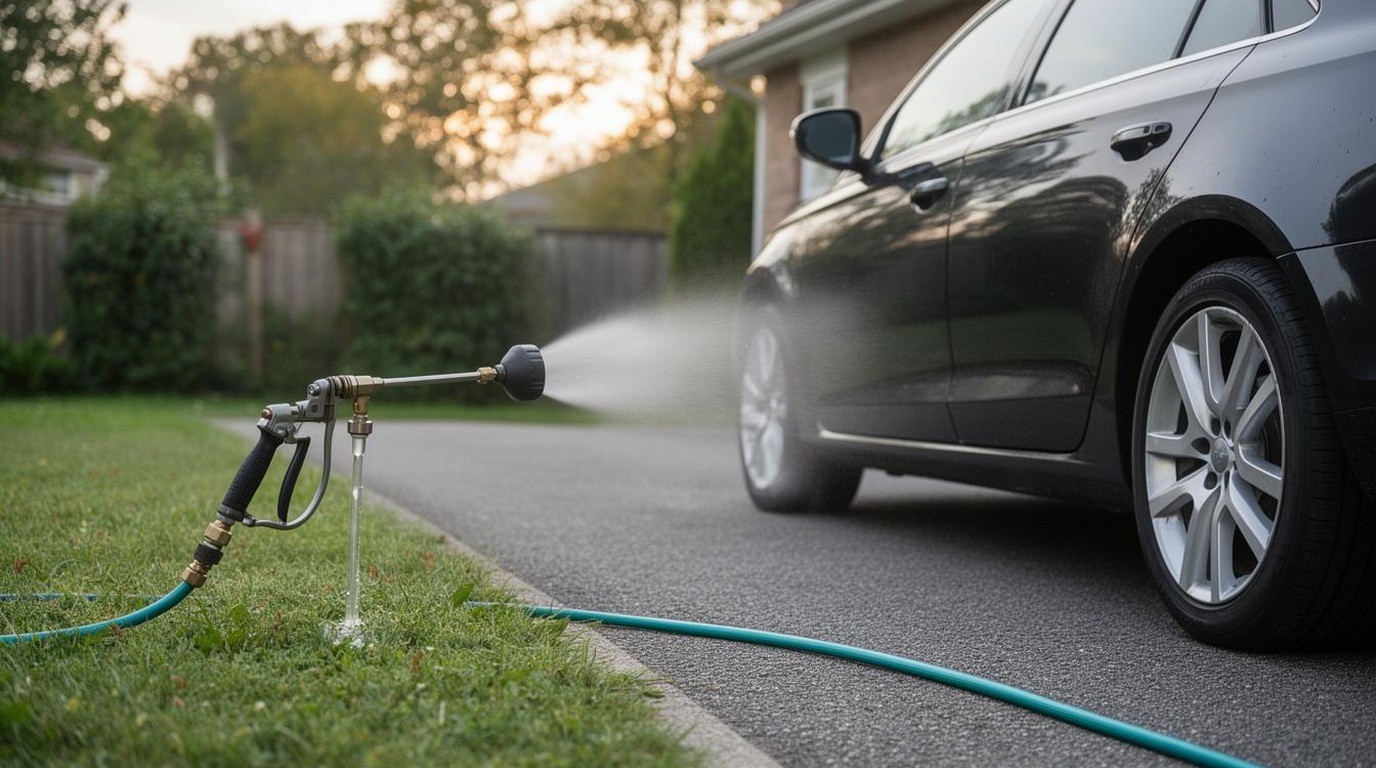
A foam cannon promises the thick, clinging suds you see in professional car washes, and a pressure washer promises to rinse the car faster than a garden hose ever could. Both tools can make a home wash more pleasant and more efficient. Both can also damage paint, trim and wiring when they are used carelessly, and the power rating on the box says little about how safely they will be used in a driveway.
This guide explains how pressure and flow ratings work, how foam cannons dilute and spray soap, how nozzle angles change the impact of the spray and what safety precautions protect you and your car. It describes general equipment behavior and does not recommend specific products. Read the manufacturer’s manual before use, since settings and limits differ between models.
Read this if you want to use a foam cannon or pressure washer at home for car washing. You can skip it if you already use a professional wash and do not plan to wash at home.
Pressure and flow
Pressure washers are rated in pounds per square inch (PSI) and gallons per minute (GPM). PSI describes how hard the water hits the surface, while GPM describes how much water the machine delivers. A high PSI can strip dirt quickly, but it can also damage paint, decals, rubber seals and plastic trim. For car washing, a moderate setting with a wide spray is generally safer than a narrow, powerful jet.
Many home units are more powerful than a car needs. Choose a machine that delivers enough flow to rinse effectively, and use the lowest setting that removes dirt. Keep a respectful distance from the paint and never hold the wand close to a single spot for long.

How a foam cannon works
A foam cannon attaches to the pressure washer and mixes a car-wash soap with water and air to produce foam. The foam clings to the paint and loosens dirt before you wash, which reduces the amount of contact with the surface. The thickness of the foam depends on the soap concentration, the water pressure and the foam cannon design.
Use a soap made for car washing, following the dilution instructions on the label. Strong household detergents can strip wax and sealants, and some dry out plastic trim. Let the foam dwell for a few minutes, as the label suggests, and then rinse from the top down.
Nozzle angles and the spray
Pressure washer nozzles come in a range of angles, from very narrow to very wide, and many sets include a low-pressure soap nozzle. A narrow nozzle concentrates force into a small area and should be used with caution on a car. A wide nozzle spreads the water and is gentler. The soap nozzle is designed for applying detergent at low pressure, and it is the safest choice for foam and general washing.
Keep the spray moving and hold the nozzle at an angle to the surface rather than straight on. Avoid spraying directly at seals, badge edges and loose trim, because the high pressure can lift or tear them.
Safety rules that matter
Pressure washers are powerful tools, and the spray can cause injury. Wear eye protection and closed shoes, and keep hands and feet clear of the spray. Never aim the wand at a person, an animal or yourself. Use the machine only with an electrical outlet protected by a ground fault circuit interrupter, or GFCI, and keep the cord and connections dry. Follow the manufacturer’s instructions for water temperature, since many units are not designed for hot water.
Avoid spraying the engine bay, electrical connectors and the air intake. Water in these areas can cause damage, and the cleaning is better done with a cloth and a light touch. Let the car dry in the sun or with a clean towel once you have rinsed it.
- Soap nozzle. Spray pattern: Low pressure, wide. Typical use: Applying soap and foam.
- Wide angle. Spray pattern: Gentle spread. Typical use: Rinsing the body.
- Narrow angle. Spray pattern: Concentrated jet. Typical use: Only for specific cleaning with caution.
Making the most of the equipment
Start by rinsing the car to remove loose dirt. Apply foam from the bottom of the car upward, which prevents clean areas from being dirtied by runoff. Wash with a clean mitt, rinse with the pressure washer on a wide setting and dry thoroughly. Clean the wheels separately with a dedicated brush and cleaner, since brake dust is hard on paint and rinses away poorly if it dries.
Our guide to waxes, sealants and ceramic coatings explains how to protect the paint once it is clean, and the wash routine works best when the surface is prepared properly.
Water quality and spotting
Hard water leaves mineral spots on paint and glass, especially if it dries in the sun. If your supply is hard, consider a water softener or a dedicated final rinse with purified water. Avoid washing in direct sun, and work one panel at a time so the soap does not dry on the surface. A quick check for spots after the wash shows whether the rinse was effective.
Drying and spot prevention
Dry the car promptly with a clean, soft towel or a blower designed for car care. Work from the top down, and wring out the towel often so it does not spread grit. Pay attention to mirrors, badges and door handles, where water collects and dries into spots. A final walk-around with a soft towel catches drips before they set.
The short version
A foam cannon helps dirt come away before you touch the paint, and a pressure washer rinses quickly, but both tools reward caution. Choose a machine with enough flow for your needs, use a soap made for cars, select a wide nozzle or the soap nozzle for most jobs and keep the spray away from seals, wiring and people. Wear eye protection, use a GFCI outlet and follow the manufacturer’s instructions. A safe, careful wash protects the paint and keeps everyone around the car out of harm’s way.
Takeaways
- Choose a wide nozzle or the soap nozzle for most washing.
- Keep the spray away from seals, wiring and people.
- Use a GFCI outlet and wear eye protection.
Finishing the wash? Our guide to waxes, sealants and ceramic coatings explains how to protect the paint once it is clean.